When the Market Gets Choppy, Clear Brands Sail Smoother

The construction market is moving, but we're not going to pretend it's plain sailing.
Across the UK and Ireland, businesses are dealing with tighter margins, cautious buyers, slower decisions, rising costs, regulation, sustainability demands and the constant pressure to make every pound work harder.
In the UK, construction activity has faced renewed pressure, with April 2026 PMI figures showing contraction and rising input costs. Ireland’s outlook is more positive, supported by public investment and long-term demand, but cost pressure, uncertainty and delivery challenges are still part of the picture.
So no, this is not a “growth is coming, grand job, crack on” moment.
It’s a wee bit more complicated than that.
For in-house marketing teams, the pressure is real. Sales want better leads. Boards want clearer return. Buyers want proof earlier. Specifiers want information faster. Everyone wants the website to work harder.
And somewhere in the throes of it all, savvy marketing teams are trying to work out whether the brand is actually clear enough, or whether everyone has just got used to explaining around it.
That perspective matters.
Because when markets are cautious, unclear brands feel risky while clear brands feel easier to trust.
In a choppy market, the difference can be make or break.
When the market is uneven, your message must be clear.
The all-island construction market is not one simple story.
There is pressure, no doubt. But there is also movement. Infrastructure, water, energy, retrofit, industrial and public sector work are still creating opportunities in different ways.
The real challenge is that buyers are more selective: they are looking harder at value, proof, credibility and delivery confidence.
That exposes weak marketing fast.
If your proposition is muddy, buyers feel it. If your proof is buried, buyers move on. If your website says too much but explains too little, confidence drops. If your sales materials do not match the business you are now, your sales team has to do the heavy lifting your brand should already be doing.
That is not just a design problem.
It is not just a copy problem.
It is a clarity problem.
And clarity is a commercial concern.
Slow is smooth. Smooth is fast.
There is a phrase often used in high-pressure training:
“Slow is smooth. Smooth is fast.”
It means rushing under pressure creates mistakes. Calm, controlled, deliberate movement gets you there faster in the end.
That feels very relevant to construction marketing now.
The temptation is to react: post more, push harder, run another campaign, tweak the brochure.... ask the AI for ten headlines and hope one of them hits the mark!
But activity is not the same as effectiveness.
At UK Construction Week, one of the clearest takeaways was that construction marketing must shift focus from activity to effectiveness. Businesses are not simply asking agencies to “make more stuff”. They need partners who can absorb complexity, understand the pressure, fill gaps, challenge well and turn moving parts into clearer, more useful, commercially focused communication.
Better thinking upfront creates smoother movement later.
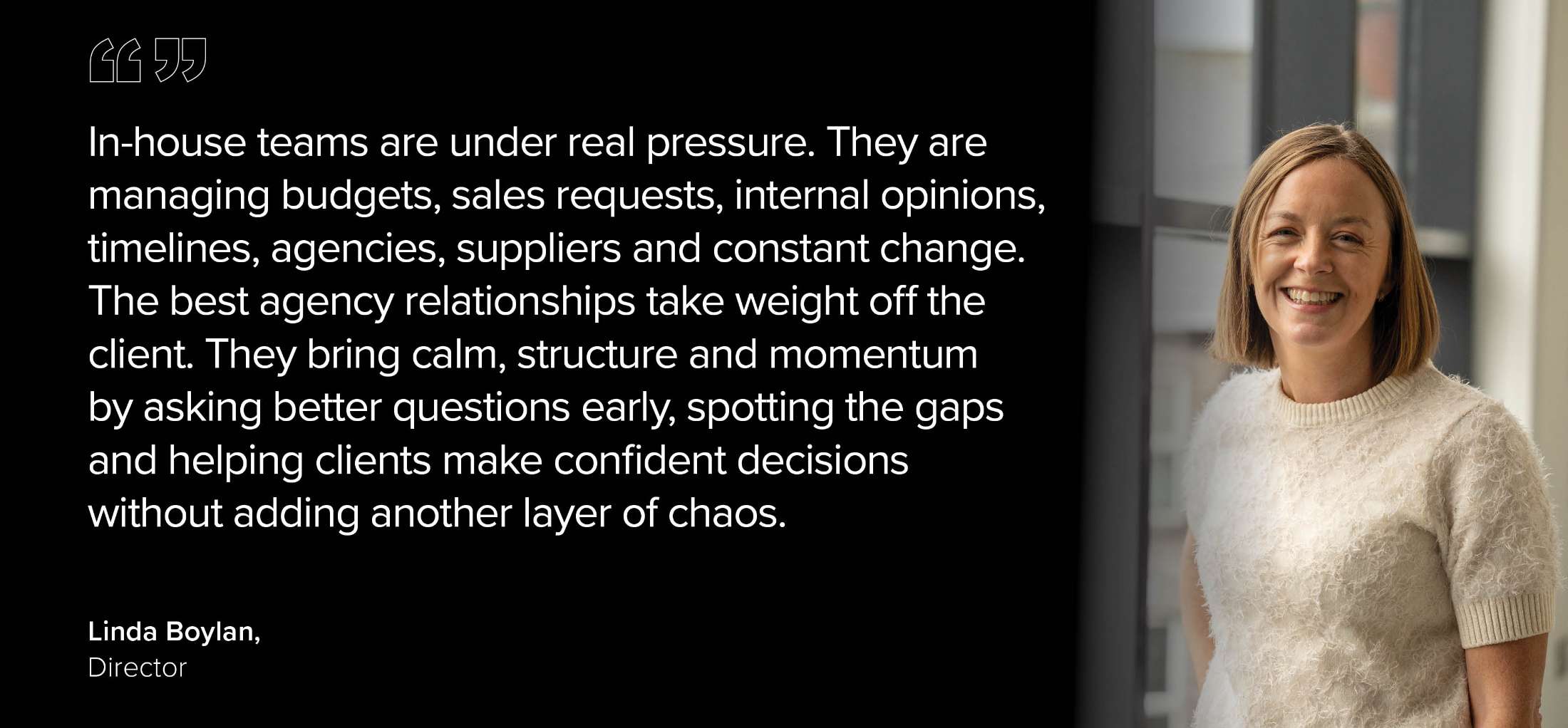
As Linda puts it:
The smart brands are staying in the water
When markets get tight, the instinct can be to pull back. Sometimes (in fact all the time), budgets just need to be carefully managed. Nobody would ever advise throwing money wildly across all channels, but disappearing completely is risky.
The consensus from marketing professionals at UK Construction Week? They're agreed that smarter businesses are not necessarily stopping spend. They are spending with more intent: staying visible, strengthening proof, supporting sales, tightening websites and making sure the brand is still on a buyers’ radar while they’re still weighing things up.
That matters because long buying journeys are normal in construction. Most buyers are not ready to buy today. But they are still noticing. Comparing. Remembering. Building confidence before the formal enquiry ever appears.
There is evidence behind this too. The IPA has long argued that businesses investing through downturns are better placed to grow in recovery. Ehrenberg-Bass research also shows that brands stopping advertising for sustained periods are more likely to lose sales and market share.
Going quiet can look like saving money this quarter, but it can cost memory, momentum and market position later.
So the answer is not spend more everywhere. It is stay visible with purpose.
Brand is not decoration. It is the structure underneath.
In construction and manufacturing, brand is often mistaken for the surface layer.
Logo. Colours. Brochure. Website. Done.
Except no.
Brand is the structure underneath. It shapes how the business is understood, how value is explained, how sales teams talk about the offer, how customers build confidence and how people remember you when the buying window opens.
In this sector, brand has to carry technical credibility, commercial relevance, product difference, sector expertise, sustainability proof, employer reputation, sales confidence and long-term trust.
That is a lot to ask of a logo and a font.
Colm says it well:
(2).jpg)
Design matters. And not because construction marketing needs to be made “sexy”. It needs to be clear, credible and commercially useful. Which, frankly, is far more attractive.
What we mean by Transform Creatively. Grow Strategically.
For Ripple, Transform Creatively. Grow Strategically. is not a decorative line.
It is a way of working.
Creative transformation means taking something complex, cluttered or underpowered and making it clearer, sharper and more compelling.
Strategic growth means making sure that creative work is pointed at the right commercial goal.
That matters in construction and manufacturing because the buying journey is long, the audiences are technical, the proof matters and the sales conversation often starts before anyone has picked up the phone.
So for us, it means clarifying the offer, sharpening the message, making the website work harder, creating stronger proof, supporting sales with better tools, building visibility before demand peaks and connecting digital activity to the buyer journey.
It is the difference between making more marketing and building better marketing.
Buyers want proof before they want a conversation
In a cautious market, buyers look for reassurance earlier.
They check the website. They scan LinkedIn. They look for case studies. They want technical downloads, certifications, accreditations, installation evidence, sustainability proof, sector experience, project photography and signs that the business can actually deliver.
They want useful evidence. And they want it quickly.
The sales conversation often starts long before anyone fills in a form. So, if the proof is hard to find, too thin, too generic or out of date, trust starts leaking before sales even gets a chance.
That is where good design and content work together.
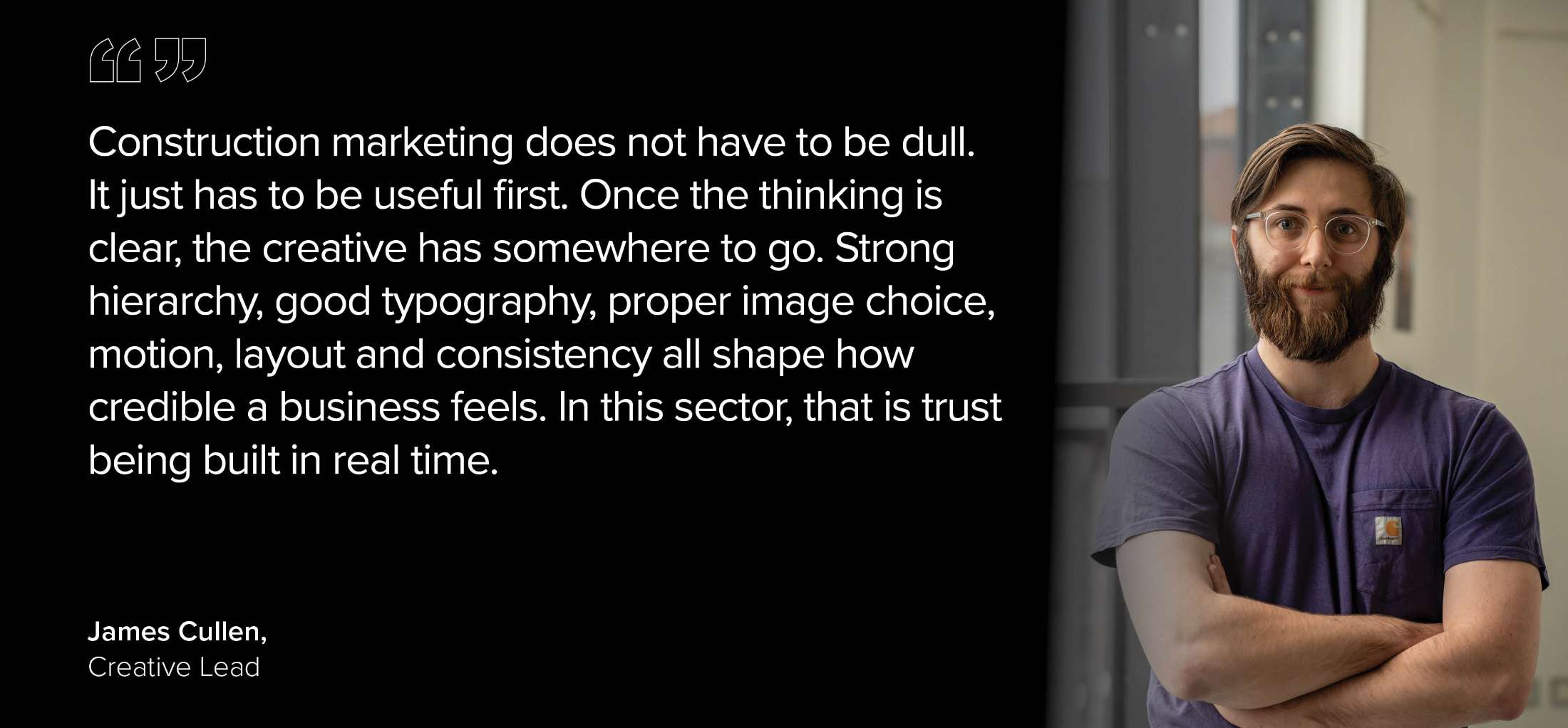
James puts it neatly:
That is how construction marketing gets better.
Clear brands make sales easier
Sales teams should not have to patch the brand together in every conversation.
They need clear propositions, strong sales decks, sector-specific one-pagers, case studies with outcomes, useful product explainers, technical content, proposal templates, follow-up emails and website pages that back them up.
If sales are constantly explaining what the brand should already make clear, marketing is not doing enough heavy lifting.
And in a choppy market, that matters more.
Because every bit of doubt slows the conversation down.
Good marketing should help people understand complex products. It should help sales teams open better conversations. It should help buyers trust faster. It should make good businesses easier to choose.
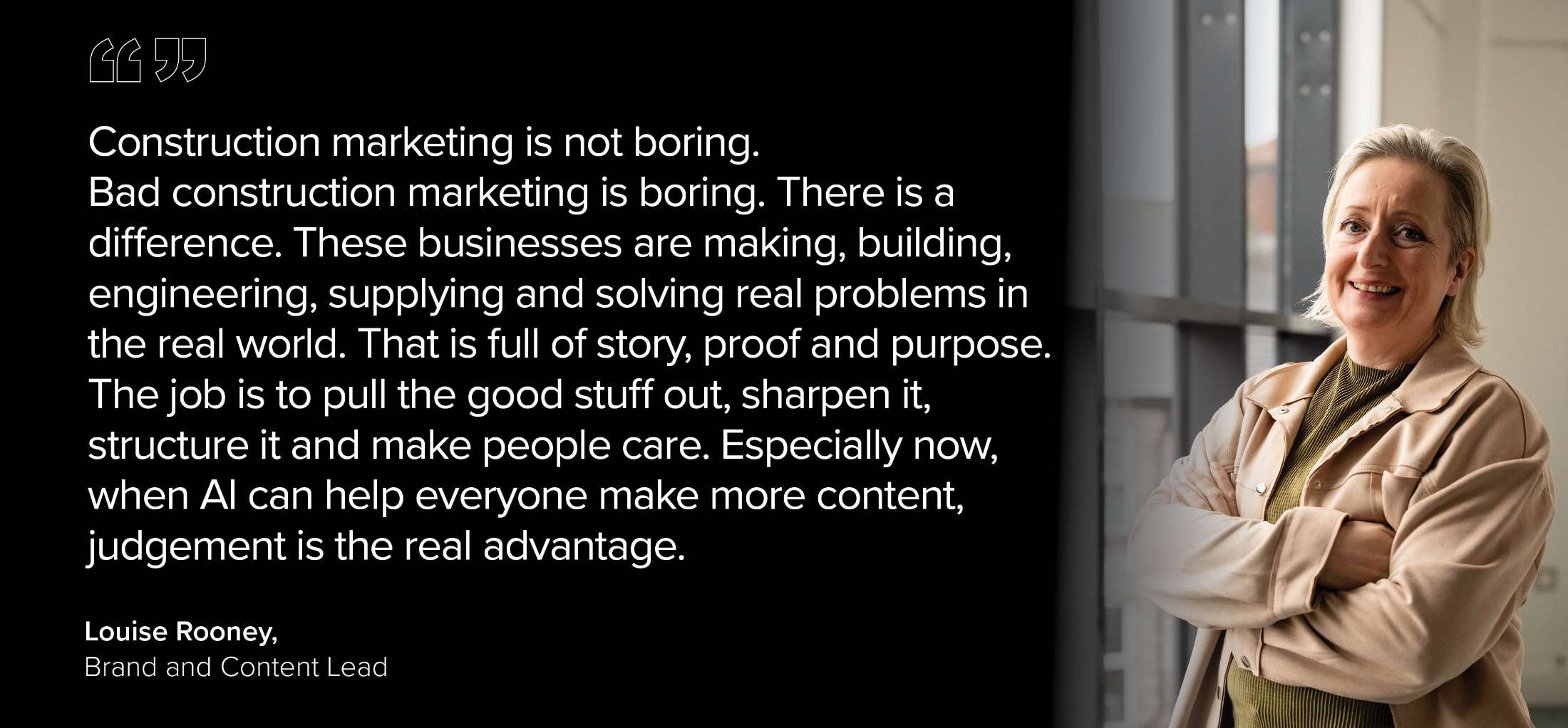
The opportunity is to take what is already strong and make it clearer, to take what is already credible and make it visible, and to take what is already useful and make it work harder.
What should construction brands fix first?
Not everything needs done at once, but the right things need done properly.
Start with the proposition. What do you want to be known for? Can people understand it quickly?
Then look at the website. Is it clear, current and built around the buyer journey?
Build better proof: case studies, outcomes, accreditations, certifications, project photography, testimonials and sector experience.
Support sales properly with decks, one-pagers, proposal templates, follow-up content and campaign tools that all tell the same story.
Tighten technical content. Make the useful stuff easy to find and easy to use.
Make ESG credible. Evidence over aspiration. No green fog.
Speak to the all-island market properly. The UK and Ireland are connected, but not identical. Local understanding matters. So does proof that feels relevant to the people, projects and pressures in each market.
And stay visible with purpose. Thought leadership, LinkedIn, email, SEO, PR, paid and campaigns should all connect back to the bigger commercial goal.
Brands move more smoothly by doing the right things with more clarity and control.
Clear brands sail smoother
The market may stay choppy for a while.
Fine.
Clear brands are built for that.
They hold their shape. They reduce doubt. They support sales. They earn trust before the buying window opens. They help in-house teams focus. They give buyers confidence. They create smoother movement through harder conditions.
That is not just better marketing.
That is Transforming Creatively & Growing Strategically.
And that is how good businesses become easier to understand, easier to trust and easier to choose.
Talk to Ripple about making your brand easier to trust, easier to understand and easier to choose.